
Extremist Groups Exploit AI Voice Cloning to Scale Digital Propaganda
 techworldalerts
Artificial Intelligence (AI) has revolutionized communication, but it has also opened doors for malicious use. Extremist groups are increasingly exploiting AI-powered voice cloning to amplify propaganda, manipulate audiences, and spread disinformation. This article explores the technology behind AI voice cloning, its misuse, the risks it poses, and strategies for mitigation, presented through an EEAT (Expertise, Authoritativeness, Trustworthiness) lens.
Understanding AI Voice Cloning
AI voice cloning is a subset of generative AI that replicates a human voice with high fidelity. Using deep learning models, the system can analyze and reproduce tone, pitch, and speech patterns from a few seconds of recorded audio. Modern AI voice tools now enable:
- High-fidelity voice replication: Accurate reproduction of a target speaker’s voice.
- Emotional modulation: Conveying anger, joy, or urgency to influence listeners.
- Multilingual output: Generating speech in multiple languages while retaining the original voice characteristics.
- Rapid content generation: Producing thousands of synthetic audio clips at minimal cost.
These capabilities, once limited to research labs, are now accessible to anyone with basic technical skills, including malicious actors.
How Extremists Exploit AI Voice Cloning
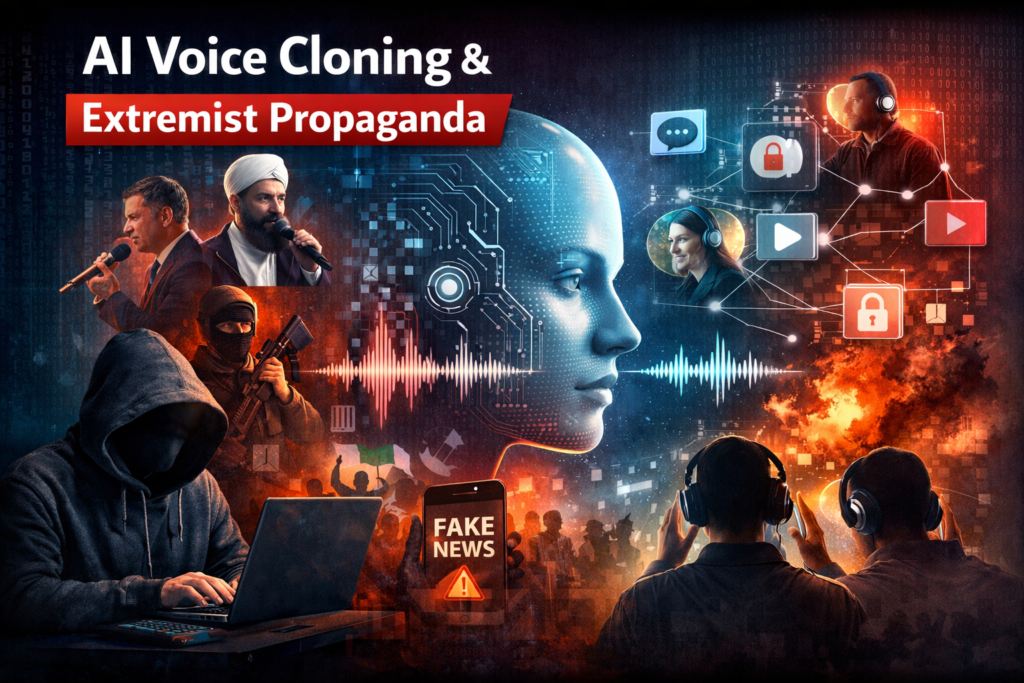
Extremist networks employ AI voice cloning as a force multiplier for digital propaganda. Key exploitation methods include:
Impersonating Trusted Figures
Cloning voices of influential leaders, journalists, or public figures allows extremists to fabricate endorsements, mobilize followers, and spread false narratives. These fabricated messages exploit the inherent trust audiences place in recognizable voices.
Scaled Recruitment Campaigns
AI-generated voices enable personalized outreach to potential recruits across social media, encrypted messaging apps, and forums. Messages can be localized, culturally aligned, and emotionally persuasive, increasing the likelihood of engagement.
Amplifying Disinformation
Extremists produce fake audio recordings to spread false information, provoke fear, or destabilize communities. Even short voice clips can manipulate perception and create lasting doubt, making traditional fact-checking less effective.
Evading Moderation Systems
Voice-based propaganda often bypasses automated moderation systems optimized for text and images. Encrypted communication platforms further complicate detection and enforcement.
Why Voice-Based Propaganda Is More Persuasive
Humans are psychologically wired to trust voices, especially familiar ones. Voice-based propaganda delivers a more immersive experience than text, combining emotional nuance and urgency. Risks include:
- Heightened emotional influence
- Faster viral spread through audio clips
- Enhanced credibility of messages
- Accessibility for audiences with low literacy
These factors make AI-generated audio a potent radicalization tool.
Risks to Security and Society
The misuse of AI voice cloning has tangible societal impacts:
- Rapid dissemination of false information during crises.
- Increased individual radicalization and recruitment.
- Erosion of public trust in media and institutions.
- Operational challenges for law enforcement in attribution and evidence collection.
The threat extends beyond extremism to election interference, financial scams, and social destabilization.
Technical Challenges in Detection
Detecting synthetic voices is increasingly difficult due to:
- Continuous improvement of AI synthesis models.
- Limited availability of reference audio for verification.
- Lack of universal audio authenticity standards.
- High false negative rates in detection tools.
A proactive approach combining advanced detection methods and policy frameworks is critical.
Mitigation Strategies
Addressing the misuse of AI voice cloning requires coordinated action:
Platform-Level Interventions
- Implement digital watermarking for AI-generated audio.
- Monitor patterns of message dissemination to detect anomalies.
- Establish rapid takedown protocols for verified synthetic content.
Government and Policy Measures
- Develop legal frameworks regulating synthetic media misuse.
- Invest in AI forensic research and detection technologies.
- Promote cross-border intelligence sharing and collaboration.
Public Awareness and Media Literacy
Educating users about the risks of AI-generated audio is crucial. Users must learn to verify messages rather than assuming voice authenticity.
Ethical AI Development
AI developers must embed safeguards, limit access, and monitor misuse to prevent extremist exploitation. Ethical deployment reduces the digital attack surface significantly.
Future Outlook
As AI voice cloning technology improves, extremist groups will likely adopt interactive voice bots, combining voice with video and text to deliver sophisticated campaigns. Anticipating these trends is essential for law enforcement, policymakers, and technology providers.
Conclusion
AI voice cloning represents a paradigm shift in digital propaganda. Extremists now have access to tools that can convincingly mimic trusted voices, amplifying their influence and spreading disinformation at scale. Combating this threat demands a combination of technical innovation, ethical AI practices, regulatory frameworks, and informed public engagement. Strengthening defenses today is essential to maintaining trust and security in a digital world increasingly shaped by synthetic media.